
Stage 3 ELTs and why they struggle
Leadership teams I work with know they're not fully aligned. What they don't know is how misaligned they actually are. Stage three of Dave Logan's tribal leadership model, "I'm great, you're not," looks like a functioning culture because it largely is one, right up until something goes wrong.
The Achilles heel of stage three is what happens under pressure. Daniel Coyle's definition in The Culture Code is the one I keep coming back to: real feedback is uncomfortable truth-telling that confronts the gap between where a team is and where it ought to be. Stage three doesn't do this. It runs on a kind of sickly-sweet positivity where the gap goes unspoken because no one is prepared to be the one who names it.
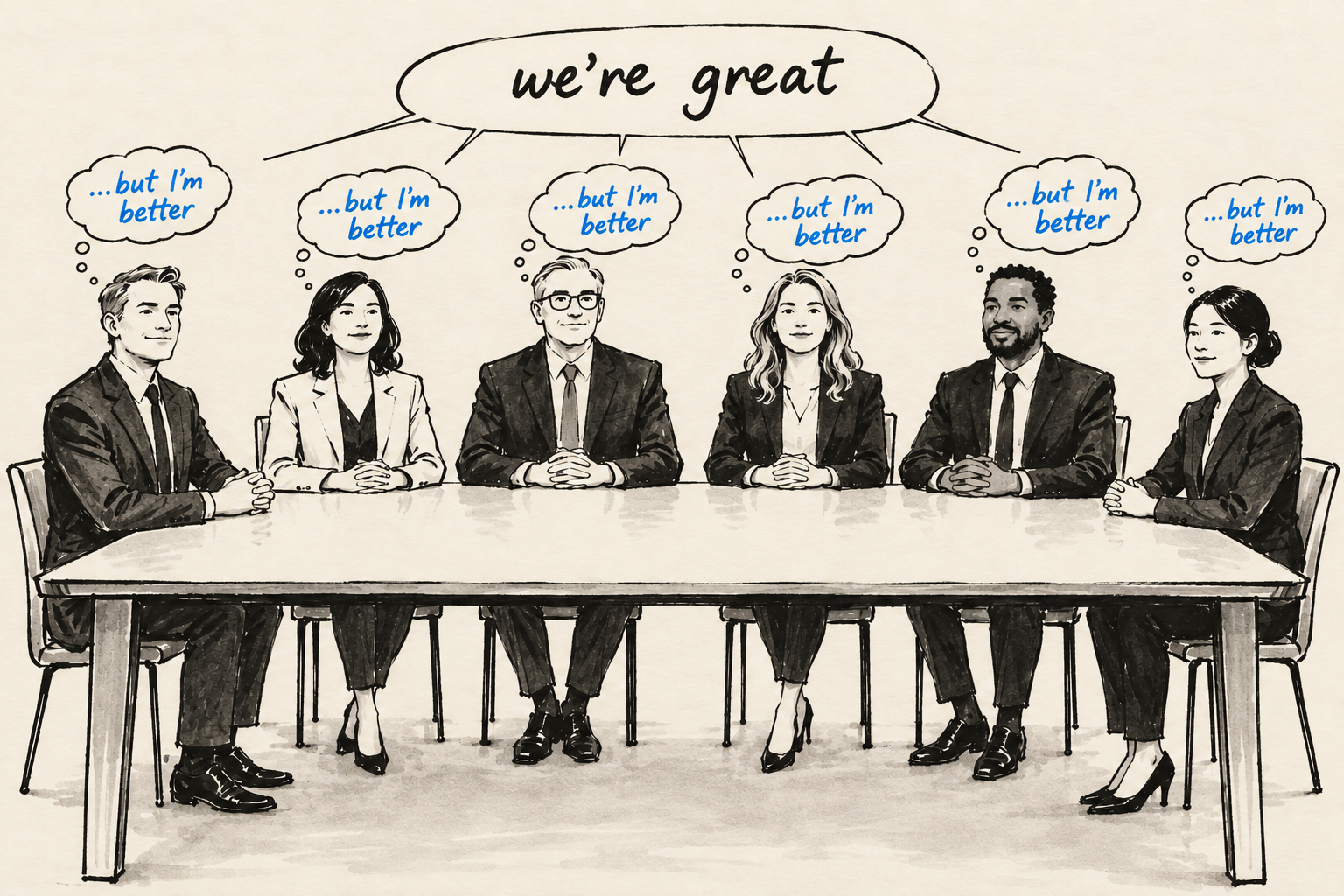
When the gap does get raised, a rare event, it lands on someone else's desk. This isn't dishonesty. It's a structural feature of stage three, dyadic trust. Two people trust each other deeply and lean on each other heavily, and trust almost no one else on the team. Picture Barry and Harry. They've worked together for years, they back each other in every meeting, and when the team underperforms, they don't examine what they're doing. They point at Sally and Jane. The gap is real. Their trust just doesn't extend far enough to include themselves in it.
That's the cultural problem. Blame finds the person outside the pair, every time, and the team never actually grows because no one inside the trusted dyad looks at themselves.
There's a second, more practical cost sitting underneath it. If Harry is stretched and needs help, Barry won't go to Sally, because the culture has never made room for that kind of vulnerability between people who haven't built dyadic trust. So the team's real capacity isn't its headcount. It's whatever Barry and Harry can carry between the two of them, and nothing more, because the rest of the room is off limits.
At executive level, this doesn't stay contained to two people. Each member of an ELT heads up a department, and culture cascades from a leader to their team with very little resistance. A lack of trust between Barry and Sally isn't just a lack of trust between two executives. It's a lack of trust, and therefore a lack of productive coworking, between two entire departments who take their cue from the top without ever being told to.
What actually works isn't a workshop that tells people to trust each other. I've run plenty and watched the effect wear off within a fortnight. Building the kind of trust that survives real feedback is slower and less comfortable than that, and it usually needs someone outside the team to hold the room while the first honest exchange happens, because inside the team the same dyadic loyalty that created the problem will protect it from being named.
The harder truth is that most leadership teams would rather live with the blame pattern than do that work, because it's quieter. Stage three feels stable right up until the moment it's tested, and by then the cost of not having built real trust is no longer theoretical.